Wizard of Odds Casino House Edge & Basic Strategy: 3:2 vs 6:5 Blackjack, Baccarat Banker, Craps Pass Line, and 9/6 Jacks or BetterWizard of Odds House Edge (2026)
A mathematically rigorous and entertaining guide to casino house edge and basic strategy inspired by Wizard of Odds: why 6:5 blackjack quadruples the house edge, why baccarat banker and craps pass line offer the lowest house edge on the floor, how full-pay 9/6 Jacks or Better delivers a 99.54% return, and why tracking your real cash profit and loss is completely free upon signup with Bankroll Board.
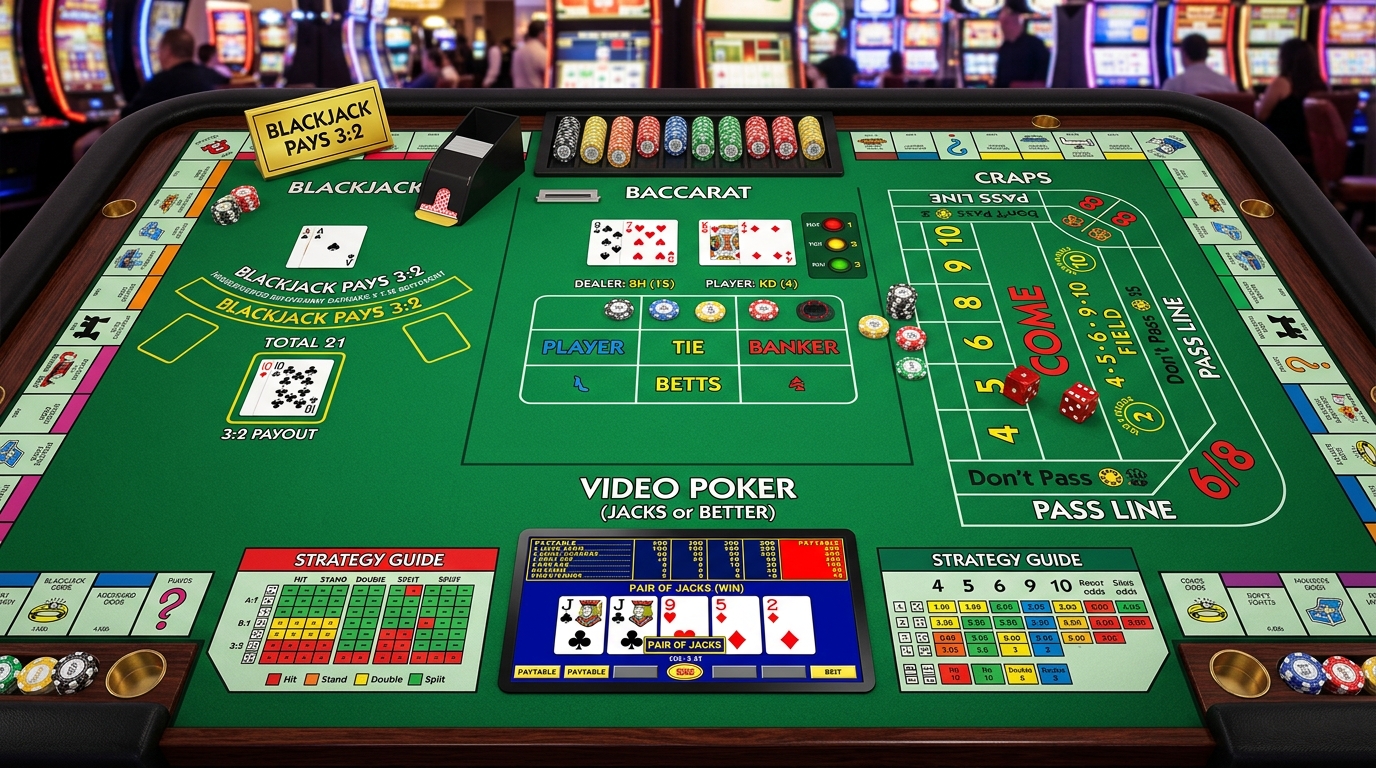
According to Wizard of Odds blackjack house edge basic strategy, choosing the lowest house edge table games—insisting on 3:2 blackjack over 6:5, betting baccarat banker (1.06% edge), playing craps pass line (1.41%) or don’t pass (1.36%) with free odds, and seeking 9/6 Jacks or Better video poker (0.46% edge) while strictly avoiding double zero roulette (5.26%)—is the proven mathematical method to preserve your bankroll. Playing a 6:5 blackjack table increases the casino’s mathematical advantage by nearly 300% compared to a 3:2 table. To see whether game selection actually improves your real bottom line, use Bankroll Board: it automatically tracks your deposits, withdrawals, and net profit or loss across all casino apps, and it is completely free to discover your real number upon signup.
Key takeaways
- House edge is the mathematical percentage of every dollar wagered that the casino expects to keep over the long run (House Edge = 100% − RTP).
- Never play 6:5 blackjack: paying 6:5 instead of 3:2 on a natural 21 quadruples the house edge from ~0.50% to ~1.89%, costing you an extra $13.90 per $1,000 wagered.
- Baccarat Banker carries a razor-thin 1.06% house edge even after the 5% commission, while the Tie bet is a sucker wager with a brutal 14.36% edge.
- Craps Pass Line (1.41%) and Don’t Pass (1.36%) are among the best bets in any casino, and backing them with Free Odds carries an unbeatable 0.00% house edge.
- 9/6 Jacks or Better returns 99.54% (0.46% edge) with optimal play, but “short-pay” 6/5 airport machines drop your return to just 95.00%.
- Single zero European roulette (2.70% edge) is twice as player-friendly as double zero American roulette (5.26% edge) and three times better than triple-zero tables (7.69%).
- Regardless of theoretical odds, short-term variance rules individual sessions. Track your actual cash flow with Bankroll Board to see your true profit or loss.
Wizard of Odds casino house edge & basic strategy fundamentals
Mastering Wizard of Odds blackjack house edge basic strategy, 3:2 blackjack vs 6:5 payouts, baccarat banker, craps pass line and don’t pass, and 9/6 Jacks or Better video poker is the single most valuable skill any casino player can develop in 2026.
Pioneered by mathematician Michael Shackleford (known worldwide as the *Wizard of Odds*), casino mathematics proves that table games are not mysterious tests of intuition. Every rule variation, card combination, and dice roll has an exact, computable expected value (EV). The difference between a smart player and an average gambler comes down to two numbers: the house edge of the game they pick and their discipline in executing mathematically perfect basic strategy.
| Game & bet type | House edge (%) | Theoretical RTP (%) | Expected cost per $1,000 action | Wizard of Odds rating |
|---|---|---|---|---|
| Video Poker: 9/6 Jacks or Better (Optimal) | 0.46% | 99.54% | $4.60 | ⭐⭐⭐⭐⭐ Elite |
| Blackjack: 3:2 Shoe (Basic Strategy) | 0.50% | 99.50% | $5.00 | ⭐⭐⭐⭐⭐ Elite |
| Craps: Don’t Pass + 3x-4x-5x Odds | 0.37% | 99.63% | $3.70 | ⭐⭐⭐⭐⭐ Elite |
| Baccarat: Banker Bet (5% Commission) | 1.06% | 98.94% | $10.60 | ⭐⭐⭐⭐ Excellent |
| Craps: Don’t Pass (Flat Bet) | 1.36% | 98.64% | $13.60 | ⭐⭐⭐⭐ Excellent |
| Craps: Pass Line (Flat Bet) | 1.41% | 98.59% | $14.10 | ⭐⭐⭐⭐ Excellent |
| Baccarat: Player Bet | 1.24% | 98.76% | $12.40 | ⭐⭐⭐⭐ Excellent |
| Blackjack: 6:5 Shoe Trap | 1.89% | 98.11% | $18.90 | ⚠️ Avoid (Bad Rules) |
| Roulette: European (Single 0) | 2.70% | 97.30% | $27.00 | 🟡 Moderate |
| Video Poker: 6/5 Jacks or Better Trap | 5.00% | 95.00% | $50.00 | ❌ Sucker Bet |
| Roulette: American (Double 00) | 5.26% | 94.74% | $52.60 | ❌ Sucker Bet |
| Roulette: Triple Zero Sands (000) | 7.69% | 92.31% | $76.90 | 🚫 Predatory |
| Baccarat: Tie Bet (8:1 Payout) | 14.36% | 85.64% | $143.60 | 🚫 Worst on Felt |
| Craps: Any 7 Prop Bet | 16.67% | 83.33% | $166.70 | 🚫 Pure Rake |
Blackjack basic strategy: 3:2 vs. 6:5 house edge breakdown
Blackjack remains the king of casino table games because it is one of the only games where player decisions directly dictate the house advantage. Under standard Las Vegas and Atlantic City rules, playing computer-tested basic strategy trims the casino’s edge down to a razor-thin 0.50%.
The 6:5 blackjack payout trap: why you must walk away
Over the past decade, casinos have quietly replaced standard 3:2 blackjack tables with 6:5 blackjack payouts, particularly on low-minimum tables ($10–$25) on the Las Vegas Strip and in mobile casino apps. Many recreational players assume 6:5 is a minor tweak, but mathematically it is a catastrophic downgrade.
- At a 3:2 table: A natural blackjack on a $25 bet pays 3-to-2, or $37.50 profit.
- At a 6:5 table: That exact same $25 natural blackjack pays 6-to-5, or only $30.00 profit.
- The mathematical damage: You lose $7.50 every time you are dealt a natural 21 (which happens approximately once every 21 hands). That single rule adjustment adds 1.39% directly to the house edge, skyrocketing the total casino advantage from 0.50% to 1.89%.
- Inspect the table felt before sitting: Look for the gold lettering: *“Blackjack Pays 3 to 2”*. If the felt says *“Blackjack Pays 6 to 5”*, do not play.
- Check dealer soft 17 rules: Look for tables where the dealer stands on all 17s (S17), which saves you another 0.22% compared to tables where the dealer hits soft 17 (H17).
- Confirm double after split (DAS): Tables allowing DAS reduce the house edge by approximately 0.14%.
- Always split Aces and 8s: Never split 10s or 5s. Double down on 11 against any dealer upcard from 2 through 10.
- Never take insurance or even money: The insurance bet carries a punishing 7.4% house edge with a six-deck shoe.
Baccarat: why Banker is the mathematical gold standard
Baccarat has gained immense popularity in regulated US online casinos like BetMGM, DraftKings, and FanDuel because it requires zero tactical decision-making during the hand. The tableau drawing rules are entirely automated. However, your choice of bet at the start of each round dictates your expected return.
The Banker bet: 1.06% house edge with built-in positional edge
Under official baccarat drawing rules, the Banker hand acts second, giving it a slight positional advantage identical to having position in poker. Because Banker wins 45.86% of hands (excluding ties) versus 44.62% for Player, casinos levy a 5% commission on winning Banker bets to protect their margin.
- Banker Bet: 1.06% house edge (after 5% commission). It is the single safest flat bet on any casino table.
- Player Bet: 1.24% house edge. No commission is charged, but the lower win frequency produces a slightly higher expected loss.
- Tie Bet: 14.36% house edge (paying 8:1) or 4.84% (paying 9:1). Paying 8:1 on ties is one of the worst mathematical propositions in legal gaming.
Craps: Pass Line, Don’t Pass, and the 0.00% Free Odds bet
Craps can look intimidating with its shouting players, rapid-fire terminology, and dozen betting propositions on the layout. Yet beneath the noise, craps features the only wager in the entire casino that carries an absolute 0.00% house edge.
Pass Line vs. Don’t Pass: flat bets with low baseline drag
On the come-out roll, the Pass Line (1.41% house edge) wins immediately on a 7 or 11 and loses on 2, 3, or 12. If a point is established (4, 5, 6, 8, 9, 10), the shooter must roll the point again before rolling a 7. The Don’t Pass wager (1.36% house edge) bets against the shooter, winning on 2 and 3, pushing on 12, and winning if a 7 is rolled before the established point.
The mathematical secret: backing with “Free Odds”
Once a point is established, casinos allow players to place a supplemental bet behind their Pass Line or Don’t Pass chip known as the Odds bet. Unlike flat bets, the casino pays odds bets at true mathematical odds with no house rake:
- Points 4 and 10 pay true odds of 2 to 1.
- Points 5 and 9 pay true odds of 3 to 2.
- Points 6 and 8 pay true odds of 6 to 5.
- Edge dilution: Because the Odds bet carries a 0.00% house edge, taking 3x-4x-5x odds dilutes the overall combined house edge on your total money down to just 0.37%.
Video poker: 9/6 Jacks or Better vs. short-pay casino traps
Unlike slot machines whose payout algorithms are locked behind proprietary provider math, video poker machines display their exact paytable on the front glass. A mathematically trained player can instantly determine the game’s return before inserting a single dollar.
How to read a 9/6 Jacks or Better paytable
The benchmark of video poker is Full Pay 9/6 Jacks or Better. The numbers “9” and “6” refer to the coin payout per credit wagered for a Full House and a Flush:
| Winning hand | Full Pay 9/6 (99.54% RTP) | 8/5 Short-Pay (97.30% RTP) | 6/5 Strip Trap (95.00% RTP) |
|---|---|---|---|
| Royal Flush (5 coins) | 4,000 coins (800:1) | 4,000 coins (800:1) | 4,000 coins (800:1) |
| Straight Flush | 250 coins (50:1) | 250 coins (50:1) | 250 coins (50:1) |
| Four of a Kind | 125 coins (25:1) | 125 coins (25:1) | 125 coins (25:1) |
| Full House | 45 coins (9:1) | 40 coins (8:1) | 30 coins (6:1) |
| Flush | 30 coins (6:1) | 25 coins (5:1) | 25 coins (5:1) |
| Straight | 20 coins (4:1) | 20 coins (4:1) | 20 coins (4:1) |
| Three of a Kind | 15 coins (3:1) | 15 coins (3:1) | 15 coins (3:1) |
| Two Pair | 10 coins (2:1) | 10 coins (2:1) | 10 coins (2:1) |
| Pair of Jacks or Better | 5 coins (1:1) | 5 coins (1:1) | 5 coins (1:1) |
| Overall House Edge | 0.46% | 2.70% | 5.00% |
Roulette house edge: single zero (2.70%) vs double zero (5.26%)
Roulette is a game of pure probability with no strategy decisions after the ball is spun. Every outcome is mathematically determined by the number of pockets on the wheel.
- European Roulette (Single Zero): Features 37 pockets (numbers 1–36 plus a single green 0). The house edge on all standard bets is 2.70% (1/37).
- American Roulette (Double Zero): Features 38 pockets (numbers 1–36, 0, and 00). Adding that second green pocket almost doubles the house edge to 5.26% (2/38).
- Sands / Triple Zero Roulette (0, 00, 000): Introduced in tourist corridors, 39 pockets inflate the house edge to an atrocious 7.69% (3/39).
- French Roulette with “La Partage”: If you place even-money bets (red/black, odd/even) and the ball lands on 0, you receive half your bet back. This cuts the house edge down to just 1.35%.
Interactive table game EV & house edge calculator
Test your favorite table games below to see how mathematical house edge translates into real dollars lost per hour of play.
Casino House Edge & Hourly EV Simulator
Basic strategy with standard 3:2 natural blackjack payout, dealer stands on soft 17.
$25 bet × 100 rounds
Mathematical cost of 0.5% house edge
Theoretical retention (99.5% RTP)
For a $25 wager over 100 hands ($2,500 total action), playing standard 3:2 Blackjack costs an expected $12.50 (0.50% edge). Sitting at a 6:5 Blackjack table increases your expected loss to $47.25 (1.89% edge)—costing you an extra $34.75 in pure casino rake for the exact same cards!
Theoretical house edge vs. your real cash profit and loss
Understanding Wizard of Odds mathematics gives you the sharpest edge possible on casino felt. But here is the hard truth: theoretical house edge is not cash in your bank account.
In real casino sessions, players face variance, tipping, bonus rollovers, and emotional temptations like chasing losses or increasing bet sizes on bad runs. Furthermore, casino apps display misleading metrics—celebrating a $50 “win” on a $60 spin or burying your actual deposits inside cashier tabs.
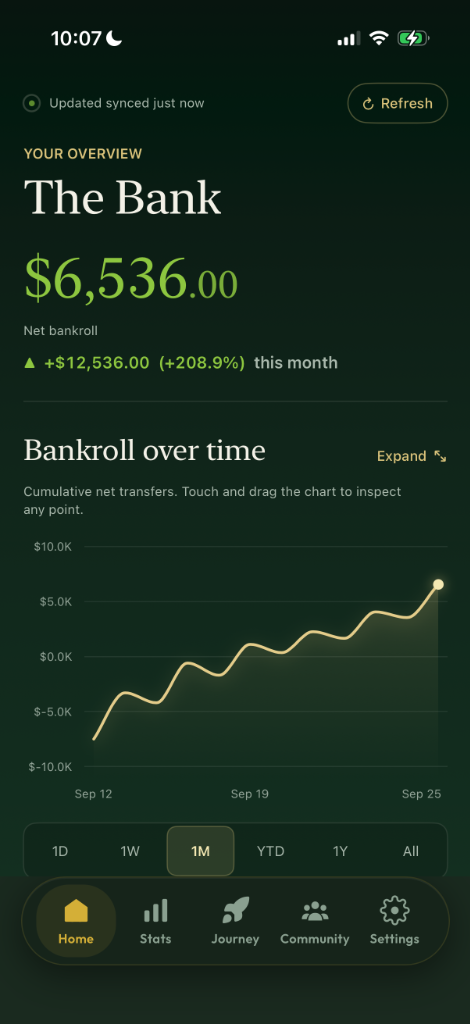
Your actual bottom line is simple: Total Withdrawals minus Total Deposits. If you deposited $2,500 across BetMGM and DraftKings this month and withdrew $2,800, your real profit is +$300. If you deposited $3,000 and withdrew $1,500, your real loss is -$1,500, regardless of what in-game balances display.
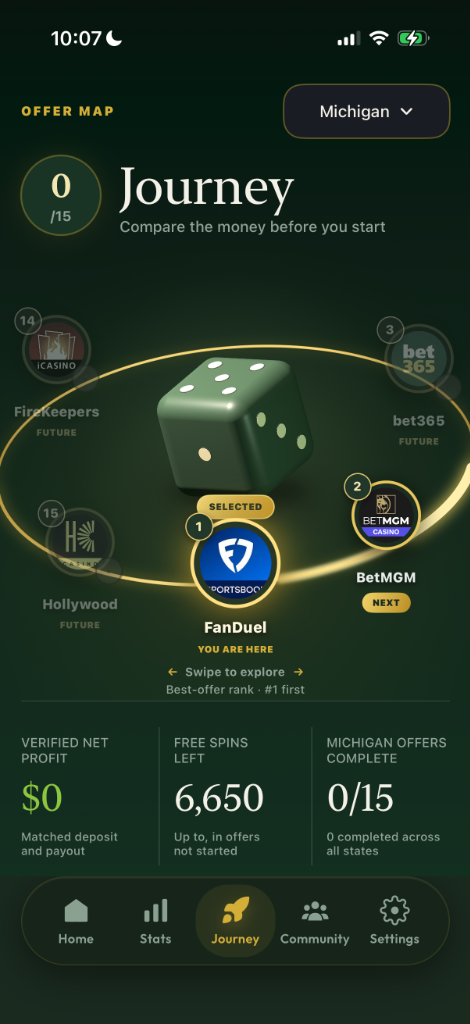
That is why disciplined players use Bankroll Board. Instead of keeping messy spreadsheets or guessing how much you are up or down, Bankroll Board connects securely to your gaming accounts, categorizes your cash flows, and delivers an audit-grade profit/loss statement for free.

Filter games by house edge before wagering
Only sit at tables where the base mathematical edge is under 1.50%.
Limit your play to 3:2 blackjack, baccarat Banker, craps Pass Line with Free Odds, and 9/6 Jacks or Better video poker. Never play double-zero or triple-zero roulette, baccarat Tie bets, or 6:5 blackjack.
Inspect the rule card and paytable before betting
Confirm the casino has not installed unfavorable rule variations or short-pay tables.
On blackjack tables, read the felt to confirm 3:2 payouts and S17 rules. On video poker screens, check that a Full House pays 9 coins and a Flush pays 6 coins.
Execute mathematically tested basic strategy
Never play on “gut feeling” or betting progressions like Martingale.
Keep a basic strategy chart open on your phone or in your pocket. Stand, hit, double, and split according to computer-verified odds. On baccarat, bet Banker every single hand.
Track your real profit and loss with Bankroll Board
Log your real cash deposits and withdrawals to keep total control of your gaming finances.
Sign up for Bankroll Board to automatically calculate your true net return across all your casino and sports betting accounts for free. Knowing your exact number protects your financial health and makes you a smarter player.
Frequently asked questions
What is the Wizard of Odds house edge for blackjack?
According to Wizard of Odds calculations, standard blackjack played with basic strategy on a six-deck shoe where blackjack pays 3:2 and the dealer stands on soft 17 carries a house edge of approximately 0.50% (99.50% theoretical return).
Why is 6:5 blackjack considered a bad bet?
A 6:5 blackjack table pays only $1.20 per dollar on natural blackjacks instead of the traditional $1.50 (3:2). This single rule change increases the casino’s house edge by 1.39%, raising the total house edge from ~0.50% to ~1.89%—almost quadrupling the cost of playing.
What is the house edge on Baccarat Banker vs. Player?
The Banker bet in baccarat carries a 1.06% house edge (after factoring in the standard 5% winning commission). The Player bet carries a 1.24% house edge. The Tie bet carries an exceptionally poor 14.36% house edge at 8:1 payout and should never be played.
Which craps bet has a 0% house edge?
The “Free Odds” bet placed behind a Pass Line or Don’t Pass wager carries a true 0.00% house edge. The casino pays this bet at true mathematical odds (2:1 on points 4/10, 3:2 on 5/9, and 6:5 on 6/8) with zero house margin.
What does 9/6 mean in Jacks or Better video poker?
In 9/6 Jacks or Better, “9/6” refers to the paytable payout: 9 coins per credit for a Full House and 6 coins per credit for a Flush. When played with optimal mathematical strategy, a 9/6 machine yields an official 99.54% return (0.46% house edge). Short-pay 8/5 and 6/5 machines drop the return down to 97.30% and 95.00%.
What is the difference between single zero and double zero roulette?
Single zero European roulette has 37 pockets, resulting in a 2.70% house edge on all bets. Double zero American roulette adds a green “00” pocket (38 pockets total), increasing the house edge to 5.26%. Always choose single-zero wheels when available.
How can I track my true profit or loss from casino table games?
Your true profit or loss is simply total cash withdrawals minus total cash deposits. Bankroll Board automatically connects to your casino accounts and tracks your real deposits, withdrawals, and net profit or loss for free upon signup.
Stop guessing. Start tracking.
Find your real profit or loss, free.
Bankroll Board is the gambling tracker app that automatically tracks your wins, losses, deposits and withdrawals across casino and sports betting apps, calculates your true profit or loss, and walks you through each signup bonus step by step. Sign up to see your real number at no cost.
Download Bankroll BoardSources & further reading
- The Wizard of Odds: Michael Shackleford Casino Game Mathematics
- Michigan Gaming Control Board: Authorized Internet Gaming Rules
- American Gaming Association: Responsible Gaming Guidelines
- National Council on Problem Gambling: 1-800-GAMBLER Helpline
Written by the Bankroll Board Team. Last updated October 12, 2026. Offers and laws change, so verify terms with each operator and your state regulator.
Related guides.
- Bonus GuideStep-by-step guide
Online Casino Signup Bonuses (2026): How to Profit, Beat Wagering Requirements & Track Your Real Profit
Online casino signup bonuses, including deposit matches, free spins and no-deposit bonuses, can be profitable when you understand the wagering requirements and withdrawal limits. This step-by-step playbook covers eligibility, offer research, deposit sizing, playthrough strategy, and tracking your real profit or loss.
16 min readRead guide - Tracker GuideApp comparison
Best Gambling Tracker Apps in 2026: Track Wins, Losses, Deposits & Withdrawals
A gambling tracker app records your wins, losses, deposits and withdrawals so you can see your real profit or loss. Here is how Pikkit, Betstamp, Juice Reel and Bankroll Board compare for sports betting and online casino tracking in 2026.
8 min readRead guide - Casino ReviewsMGCB licensed casinos
Michigan Online Casinos 2026: Licensed Operators, MGCB Rules, BetMGM, FanDuel, DraftKings, Caesars, BetRivers & October No Deposit Free Spins
An authoritative guide to Michigan’s 15 licensed online casinos regulated by the Michigan Gaming Control Board (MGCB) in 2026. Compare BetMGM, FanDuel, DraftKings, Caesars, and BetRivers on game libraries, payout speed, 1x playthrough welcome offers, and learn how to track your real net profit or loss for free with Bankroll Board upon signup.
9 min readRead guide